
Running the businessYour break-even price
What a day has to bring in before you make a cent
Your real overhead, divided by the work you can actually do, turned into the number a quote has to beat — and a refusal when nobody has told it enough to say.
Your first 14 days are free, and nothing is charged until they are up.
What this takes off your week
How it works here
Two totals, because they answer different questions
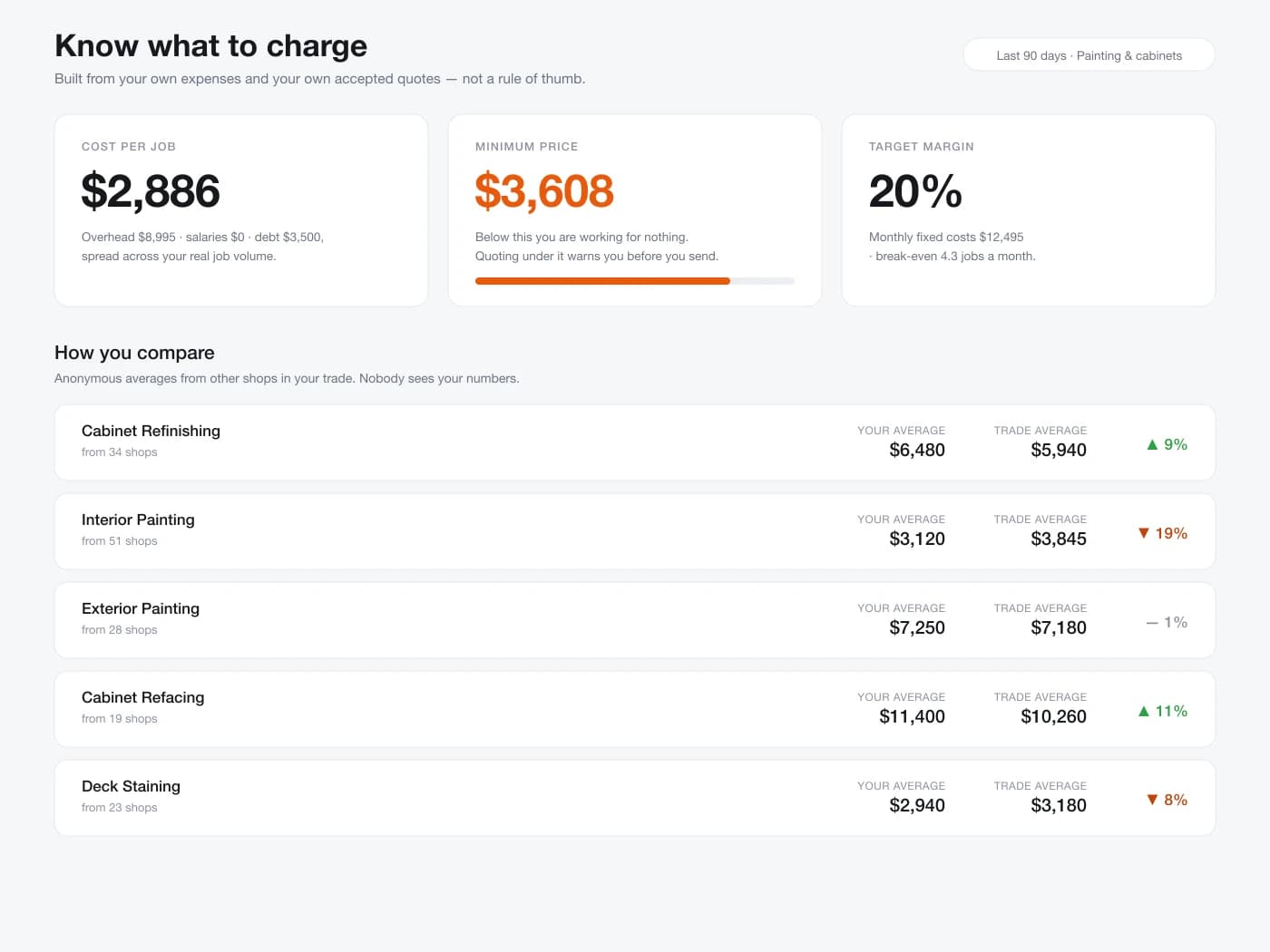
One is cash out of the door each month: overhead, salaries and the full loan payments. The other is what the work actually costs you: overhead, salaries, and depreciation and interest on what you bought with a loan.
The floor uses cost, not cash
Cost per job is the second total divided by the jobs a month your stated capacity implies, and the minimum price is that grossed up for your target margin.
Nothing is invented to fill a gap
With no capacity stated there is no figure at all. A defaulted price floor is the worst kind of padding: it is a number you would act on.
The specifics
What a day has to bring in before you make a cent, worked out from your real overhead.
- A month is 4.33 weeks
- Weekly costs and weekly capacity are converted with the same figure, so the two sides of the division agree with each other.
- The margin is clamped
- Target margin defaults to twenty per cent and is capped below a hundred, because a hundred per cent margin divides by zero — and an empty box is treated as absent rather than as zero, which would quote everything at break-even.
- The hourly floor asks for billable hours
- Not hours worked. Driving, quoting and paperwork are deliberately excluded, and the per-person rate is the floor divided by the size of the crew.
- Depreciation is in one total and not the other
- Cash burn has none of it. The cost figure carries depreciation and loan interest and drops the raw monthly loan payment, so the same truck is not charged twice.
- An unknown frequency contributes nothing
- Rather than a wrong number. A salary with no hours behind it contributes nothing too, rather than being assumed to be full time.
- It needs your cost basis switched on
- Both figures need job costing and the right to see prices. Without them it refuses rather than showing zeroes, because a panel of zeroes reads as a business that costs nothing to run.
What you get
Every plan includes all of it. Plans differ by how many people can work in the account, not by which features they are allowed to use.
Your break-even price
What a day has to bring in before you make a cent, worked out from your real overhead.
Try it on your own jobs
The first 14 days are free. Bring your own rates, your own logo and the client list you already have.
Contractors reading this also read